ADVANCED FUNCTIONAL PROTOTYPE
SYSTEMS STUDIO INFRASTRUCTURE
Signals Platform
A modular multi-sensor observation, evidence-management and correlation platform designed for structured review of aerial, astronomical and environmental observations.
Multi-monitor camera, evidence and investigation workflow
PLATFORM WORKSPACES
Functional interfaces already developed
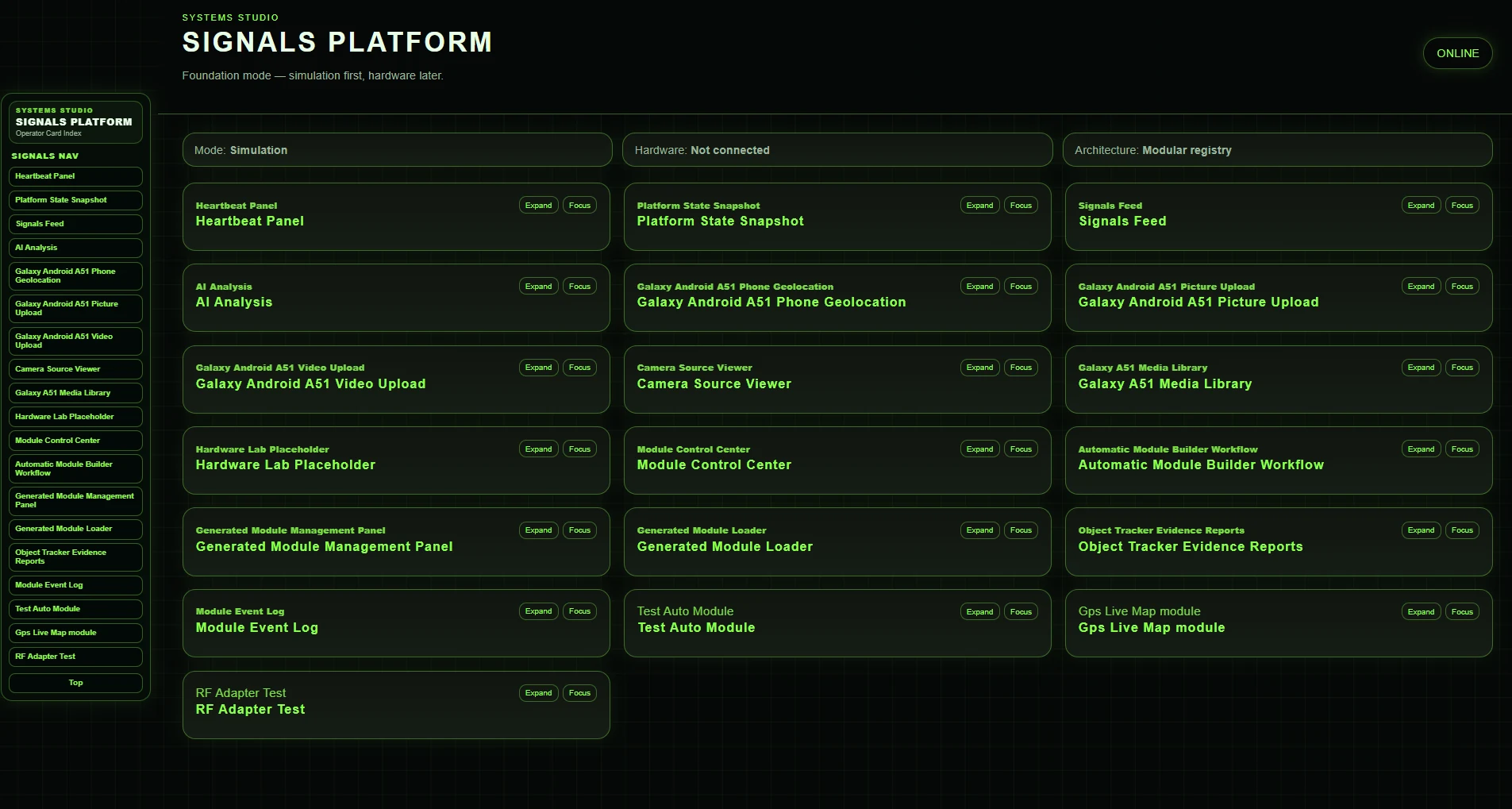
Real screenshots captured from the operational Signals Platform prototype. Select any view for full-screen inspection.
OPERATOR ARCHITECTURE
Designed for a three-monitor workspace
Separate operator surfaces allow live control, evidence review and correlation analysis to remain visible without compressing every tool into one dashboard.
01
Live Optical Operator
Camera-source viewing, telescope controls, capture, recording and persistent observation management.
02
Unified Evidence Media
Original and processed media, provenance, processing jobs, comparison, blink, overlay and synchronized zoom.
03
Evidence & Analysis
Correlation adapters, observation context, integrity review and unified PDF or JSON reporting.
CURRENTLY IMPLEMENTED
Functional platform capabilities
Observation Sessions
- Persistent observation identifiers
- Event timeline and current state
- Still-image and video evidence
- Recoverable operator workspaces
Evidence Integrity
- Immutable original media
- SHA-256 media verification
- Session evidence packages
- Processing and provenance manifests
Media Processing
- Hardware-independent job queue
- Pillow CPU reference processing
- Original-to-processed lineage
- Side-by-side, blink and overlay review
Correlation Analysis
- Aircraft correlation adapter
- Satellite orbital propagation
- Astrometry.net plate solving
- Weather and environmental context
Unified Reporting
- Consolidated correlation status
- Evidence and source limitations
- JSON report export
- Professional PDF report generation
Operator Export
- Evidence-package ZIP export
- Media download and verification
- Local-drive save workflows
- Structured evidence metadata
CAMERA & SENSOR INTEGRATION
Built to connect observation hardware
Signals Platform is intended to operate as the software, evidence and analysis layer for camera systems, telescopes, PTZ devices, mobile sensors and future AI edge nodes.
Camera and sensor sources
Telescope, DSLR, mono NIR, PTZ, mobile and network cameras
→
Signals Platform
Capture, control, evidence, correlation and reporting
→
Operator determination
Structured review with documented limitations
EVIDENCE POLICY
Correlation is not automatic identification
A correlation match indicates geometric, temporal or contextual compatibility with a candidate source. A non-match applies only to the datasets, time windows, catalogue coverage and uncertainty settings available to the adapter.
Signals Platform does not by itself determine that an observation is anomalous, extraterrestrial or non-human. Final interpretation remains an operator and investigative responsibility.
DEVELOPMENT ROADMAP
Prepared for advanced AI and optical hardware
Evidence foundation
Persistent sessions, media integrity, correlation, reports, processing jobs and comparison tools.
OpenCV processing
Motion detection, frame extraction, object detection, stabilization and annotated media variants.
Jetson and RTX nodes
Edge inference, TensorRT acceleration, real-time tracking and multi-camera target handoff.
TECHNICAL DOCUMENTATION
Jetson AI Telescope Node
Technical architecture for the telescope-mounted NVIDIA Jetson edge node, including dual-NIR camera integration, OpenCV object detection, target tracking, calibrated mount correction, image enhancement, evidence provenance, processing-node registration, power, storage and the proposed development sequence.
- Jetson Orin NX 16 GB recommended architecture
- Wide-field NIR object detection and tracking
- Cooled telescope NIR imaging integration
- OpenCV, CUDA, TensorRT and GStreamer stack
- Evidence-preserving image enhancement
- AZ-EQ6 tracking and safety-control workflow
- Signals Platform node registration
Systems Studio Jetson AI Telescope Node
Technical concept and implementation foundation
OPEN TECHNICAL PDF
DOWNLOAD PDF
PRODUCT STATUS
DISCUSS A SIGNALS PLATFORM PROJECT
Advanced functional prototype
Commercial deployment will follow hardware integration, optical calibration, field validation and operational testing.